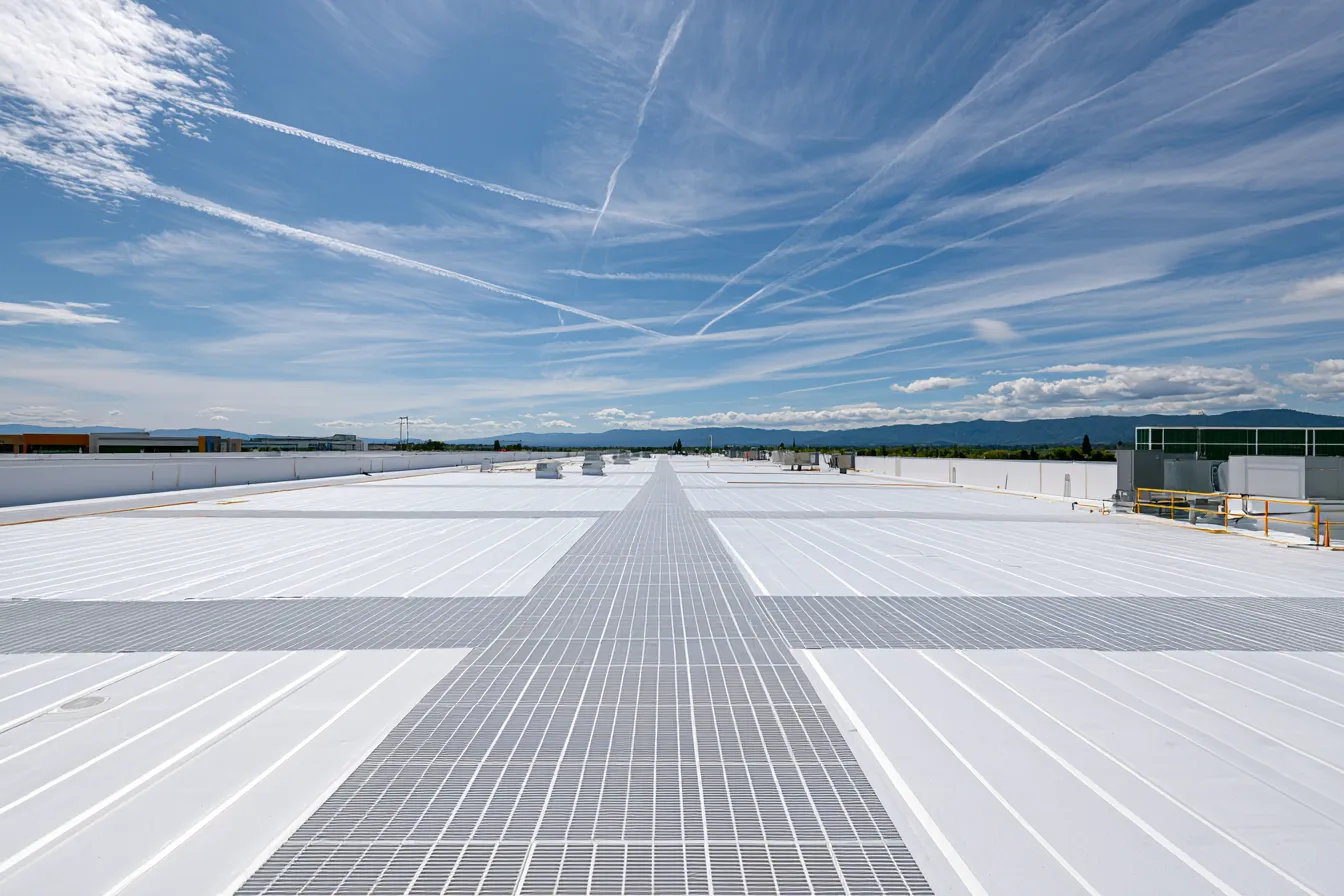
Commercial Roofing in Olathe, KS
Most commercial roofs in Olathe are flat or low-slope, and they live or die at the seams, drains, and flashings where leaks start. Kansas registers the roofer who services one under a single certificate an owner can check.
- Scope and dollars in writing, then work
- Hail-claim paperwork put in plain English
- One roofer handling the whole job
Call (913) 210-3979
How a flat commercial roof is read
Every roofing contractor registers with the state Attorney General, and the act adds no separate commercial tier, so the credential covering your building is the same one that covers a house. Every roofer we send carries an active registration certificate and current insurance before the job is scoped, so that part is handled going in.
Olathe's commercial buildings rarely wear shingles. Downtown storefronts, medical and professional offices, and warehouse floorplates on the city's industrial edges mostly run flat or low-slope membranes. A local roofer gets on the deck to read the membrane field, work the seams and drains for weak points, and check every rooftop curb, then sets the real condition down in writing before any price. A no-cost inspection starts the record.

The flat-roof systems on Olathe buildings
Picking a membrane is about fit, never preference. The deciding factors are how well the deck moves water off itself, how heavily the rooftop units get walked for service, whether a rooftop kitchen throws grease over the field, and how many years the sheet has to hold. A roofer reads the roof and writes it up before ever settling on a system name.
TPO
Common on Olathe's newer retail centers and office properties, this is a pale single-ply whose seams are fused with heat rather than adhesive tape, so the sheet behaves as one sealed surface even as it expands and contracts with the seasons. The light face bounces summer sun off the deck and trims the cooling bill. The full TPO page covers mil thickness and the welded-seam detail.
Start here →EPDM
Where a warehouse spreads a wide, open deck, this synthetic rubber is the natural fit: it stays flexible through Kansas temperature swings and can log decades of service without drama. The sheet itself rarely gives out; the seams where rolls meet are the one place that wants steady upkeep, so that is where a roofer keeps watch. The flat-roof and drainage guide covers what else a low-slope deck has to get right.
Start here →PVC
When a restaurant kitchen or any grease-venting tenant sits under the roof, this is the answer. A welded PVC sheet stands up to the fry-line exhaust and cooking grease that would eat through an ordinary membrane, and because it welds cleanly, a later repair fuses directly into the existing sheet instead of only patching over it. That staying power is what earns back its higher price.
Modified bitumen
Best suited to a smaller Olathe building whose roof takes steady foot traffic up to the rooftop units. It is reinforced asphalt supplied in rolls that are either torched down or self-adhered, and its heft is the appeal: thick enough to take a boot without worry and to shrug off a corner that drains slowly, with a multi-ply top layer that keeps its grip where water tends to sit.
Built-up roof (BUR)
The oldest and heaviest option here, built up from stacked courses of asphalt and gravel. Its whole logic is backup: with several plies overlapping, a single tired spot never breaks the roof open, and the assembly's sheer weight ignores foot traffic and a heavy rooftop load. A number of Olathe's older commercial buildings still carry one, where decades of service pay back the heavier install.
Roof coatings
Rather than a tear-off, a silicone or acrylic coat can be rolled across a roof that is worn but structurally sound, restoring the surface and adding reflective life for a fraction of replacement cost. Two conditions gate it: a cure window of warm-enough weather, so it goes down before summer, and a deck that tests dry, since sealing a coat over already-trapped moisture just locks the water underneath. The roof coatings page walks through the moisture test.
Start here →Unsure which system is overhead, or how much life it has quietly used up? One read settles both. A local roofer identifies the membrane, gives a realistic estimate of the years still in it, and photographs and dates any storm or seam damage, well ahead of any repair-or-re-roof call. For real ranges broken out by system, the new roof cost guide has them.
The scope an Olathe flat roof calls for
Almost any commercial roof lands in one of four scopes, and it is the documented read, not guesswork, that points to the right one. Whatever that read turns up gets put on paper before a single crew is scheduled.
- 01A targeted repair, held to one failure
- One failure addressed by itself: a lifting seam, a drain that pools rather than clearing, a parapet flashing turned brittle over the years, or a drip at the curb of a rooftop unit. Each gets tied back to whatever system actually sits overhead.
- 02A coating where the deck has earned it
- This only pays when the insulation underneath reads dry and intact. Given that, a coat of rolled silicone or acrylic can renew the surface at a fraction of tear-off cost. Lay one over damp or trapped moisture, though, and it simply seals the water in, so the moisture scan always precedes the recommendation.
- 03A full re-roof when the membrane is done
- A brand-new low-slope system, be it built-up, modified bitumen, or a single-ply sheet, anchored against the wind that sweeps an open Kansas deck and carefully finished at every seam and flashing. It is chosen only after patch repairs have stopped paying their way.
- 04The coat-or-replace call, weighed four ways
- One call, four inputs, and not one of them can be skipped: the shape the deck is in beneath everything, how long you intend to hold onto the building, whether water is sitting in the insulation, and how much foot traffic the roof takes day to day. All four are weighed side by side long before any crew is quoted a number.
On a flat roof, trouble stays out of sight in a way it never could on a pitched one. Stand in the parking lot and a punctured membrane or a lifted seam registers as nothing at all. Yet Johnson County has logged hail as large as three and a half inches across, big enough to split a membrane on impact, so a first visit means close-up shots of every bruise and parted seam, each stamped with the storm's date. What a flat roof keeps hidden after a hailstorm is laid out on the storm damage page.
From first read to a documented close
Your roof is documented before a single figure is named, and the work is scheduled around your operating hours.
The credentials checked before anyone goes up
That check happens before your building is ever scoped: the roofer we send already carries an active Kansas registration and current insurance. From there, a local roofer heads up to read the membrane, the seams, the drains, and the curbs, and returns with dated photos alongside a single written figure.
One scope on paper, sized to the building
Whether the answer is a repair or a replacement, it is laid out in plain terms and priced to match the building's own budget calendar, and that number is fixed before any crew gets booked. The timing of the work remains entirely yours.
Install to spec, then close it on record
The new membrane is laid, or the repair is finished to the written spec, and then every drain, seam, and flashing gets a final documented walk, photographed and dated, so the seam and drainage details are on record before the workmanship terms reach your file.
What Olathe owners ask before a flat-roof job
The questions an Olathe building owner tends to raise before green-lighting a commercial roof scope.
Q1Is an Olathe commercial roofer registered in Kansas?
Q2What does a Kansas winter do to a flat commercial roof?
Q3Coat the membrane or replace it, how is that decided?
Q4A tenant reports a drip, but the membrane is fairly new. Why?
Q5Will insurance cover storm damage to a flat commercial roof?
Q6On a new commercial roof, who backs it, the maker or the roofer?
Get your Olathe flat roof read and documented
Hand your building to Olathe Roofing Co, and a commercial roofer walks the membrane, dates every worn seam and every sluggish drain, and lays out the cost of either a repair or a complete re-roof on a single page. Nothing proceeds without your sign-off.